Whether artificial intelligence should be used in learning cannot be answered categorically. Its added value in relation to learning depends on how it is integrated into the learning process. The same AI system can provide productive support in one situation and shorten, override, or prevent thought processes in another. The crucial question, therefore, is: For whom, at what time, with what goal, and in what form can AI be used to promote learning? The SKILL model provides a framework for this. It helps to select and critically evaluate AI-supported learning tools and to design them in such a way that they stimulate, structure, and deepen thinking, rather than replacing it.
How AI is used is crucial.
A field experiment by Bastani and colleagues (2025) with approximately one thousand students in a mathematics class demonstrates this difference. Students who were allowed to use a standard chatbot during practice initially solved more problems correctly. However, without the AI assistance, they later performed worse than students who had previously worked without AI. A pre-structured version of the same language model, which provided graded hints instead of complete solutions, avoided this effect. It was not the underlying model, but its didactic design that led to different learning outcomes.
The debate should therefore not stop at the divide between prohibition and enthusiasm. The crucial factor is its pedagogical integration. It needs to be clarified under what conditions AI actually supports learning processes.
Performance is not the same as learning
Improved performance during AI use does not automatically equate to greater learning (Yan et al., 2025). A tool can deliver an immediate result, thus creating the illusion of learning success, even though no genuine skill development occurs. Sustainable learning requires learners to engage with a subject, develop their own solutions, make mistakes, and examine their reasoning. Those who outsource this cognitive work to AI and merely follow its results often process the content less deeply. Plausibly formulated explanations can also create a sense of understanding without the underlying knowledge having been independently acquired. Learners with limited prior knowledge, in particular, often fail to recognize this discrepancy. They end their practice too soon and are later unable to confidently apply or transfer what they believe they have understood without AI. Appropriate pre-structuring can counteract this. The second variant in the experiment by Bastani et al. (2025) managed usage so that the AI served as a thinking partner and not as a shortcut. This is particularly important if learners are not yet able to regulate this form of usage themselves.
Focus on competence
For AI to be used effectively in learning, age and grade level are less significant than the competence to use AI in a way that promotes learning in a specific context. This applies to learners as well as teachers. Several sub-competencies work together in this process:
- Expertise on the topic under discussion, in order to assess the technical quality of an AI response.
- Critical AI competence, in order to recognize limitations, hallucinations and plausibly formulated errors.
- Self-regulation, in order to decide when AI is useful as a thinking partner and when it becomes a mere answer machine.
- Cognitive and linguistic prerequisites, in order to formulate appropriate requests and process the responses.
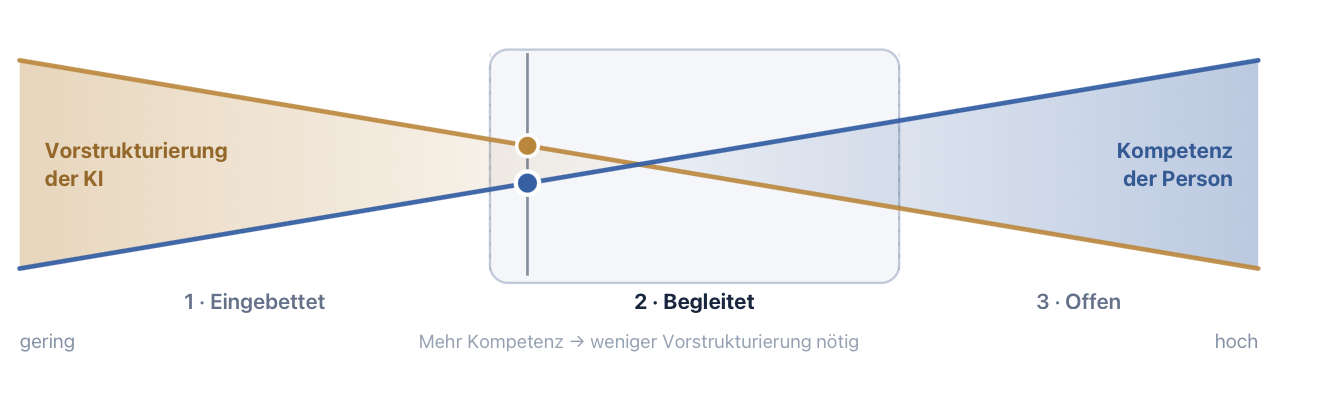
Those with limited competence in one or more of these areas require more pre-structuring. An unclear task, an unsuitable understanding of roles, or a lack of subject-specific context can be particularly detrimental to beginners. At the same time, it cannot be expected that learners will configure the necessary structure themselves, for example, through role prompts or the targeted provision of contextual knowledge. As competence grows, the requirements change: close guidance that helps beginners can hinder advanced learners. This expertise reversal effect argues against a uniform usage concept. Design and implementation should therefore be linked to competence levels, such as the UNESCO progression Understanding, Applying, and Creating (2024) or the six levels of DigCompEdu (Redecker, 2017).
The SKILL model summarizes this relationship. It serves as a guideline for the design, evaluation, and selection of AI-supported tools in educational processes.
The SKILL spectrum to try out
The following spectrum can be explored interactively. Move the point along the diagonal or use the slider. The display shows which framework conditions and which role of AI are suitable for different competence levels.
The SKILL spectrum
The lower the competence to use AI effectively for learning, the more pre-structuring the tool requires. Select a level or move the item.
Expertise in the matter
Critical AI competence
Self-regulation
Tool
Role of AI
Structure / Guardrails
Example
Purpose of the deployment
| Learning tool | Compensation for disadvantages |
|---|---|
| The outsourced work is meant to be learned in-house, therefore it must be protected. | The AI compensates for a barrier that is not the learning objective. |
| risk | NoticeThe support should remain permanently available. The goal is participation, for example through reading aloud to improve text comprehension, not the reduction of support. |
Stages based on UNESCO (2024), DigCompEdu (Redecker, 2017) and Ng et al. (2021).
Implications for embedding in learning processes
People are often beginners in what they are currently learning. Education presupposes, in particular, that learners don't yet know everything and can't reliably assess the situation. Therefore, the open, unregulated use of freely accessible chatbots should not be the norm. For many learning situations, pre-structured, application-integrated, and accessible tools are more suitable. The AI operates in the background of a didactically designed learning environment; subject-specific context and safeguards are already integrated. This is also a matter of educational equity. If effective learning requires extensive prior knowledge, technical understanding, linguistic fluency, and precise contextualization, those who are already competent benefit most. Integrated structures lower these barriers and can be gradually removed as competence grows. This also applies to teachers. Those with subject-matter and AI-related experience can use open chatbots productively for teaching and organization. Other teachers need tools that are accessible without extensive prompting skills. An AI-supported planning tool could combine integrated prompts, pre-prepared building blocks, targeted follow-up questions, and subject-based knowledge bases. With increasing sovereignty, it could be opened up more and more, for example through its own prompt extensions.
Learning tool or compensation for disadvantages?
The intended use also determines how highly structured a learning environment should be and whether individual steps can be shortened. The central question is: Is the outsourced task itself meant to be learned? If, for example, the focus is on arithmetic in early elementary school, the problem-solving process must be protected from prematurely revealing the answer. If, on the other hand, the outsourced task is not part of the learning objective, AI can take it over. For learners with disabilities, AI can therefore be not only a learning tool but also a means of participation. For example, in the case of the learning objective of text comprehension, a text-to-speech function can overcome a barrier without circumventing the actual learning objective. In such cases, the support can remain permanently available.
The SKILL Check: Selecting and evaluating tools
The five letters of SKILL also stand for five guiding questions for selecting and evaluating AI-supported learning tools:
- S – Scaffolding: Does the level of pre-structuring and support match the competence level, and can it be gradually reduced?
- K – Cognitive Activation: Does the person have to think and act independently?
- I – Integration: Is the use of the equipment tied to a learning objective and a viable task, and does the teacher maintain an overview of the work being carried out?
- L – Learning process: Are mistakes retained as learning opportunities, and which metacognitive strategies are stimulated?
- L – Long-term development: Is self-control or dependence increasing?
Significance for the design and development of AI-supported applications
The SKILL model can structure the design and development of AI-supported learning applications. It positions an application between application-integrated AI and open chatbots, taking into account the target group and the expected level of competence. This leads to concrete design decisions. Initial empirical findings can be summarized under four principles: Foundation (on what professional basis is the feedback generated?), dosage ("first you, then me"), activation (encourage active participation instead of promoting passive consumption) and Embedding (Linking to viable hybrid learning arrangements). More on these design principles.
Conclusion
Generative AI only unfolds its learning-related value when it is tailored to the task, the individual, and the learning environment. Therefore, it is crucial to determine for whom, when, and to what extent its use serves learning. Freely accessible chatbots are often insufficient for this purpose. They place high demands on prior knowledge, language skills, and self-regulation, and can, in unfavorable cases, impair learning processes. More suitable are accessible, pre-structured, and subject-matter embedded tools that are gradually opened up as competence grows. Learning effectiveness arises from the interplay of task, pre-structuring, and pedagogical support. The key rule of thumb is: AI can support thinking, not replace it.
literature
- Bastani, H., Bastani, O., Sungu, A., Ge, H., Kabakcı, Ö., & Mariman, R. (2025). Generative AI without guardrails can harm learning: Evidence from high school mathematics. Proceedings of the National Academy of Sciences, 122(26), e2422633122. https://doi.org/10.1073/pnas.2422633122
- Yan, L., Greiff, S., Lodge, JM, & Gašević, D. (2025). Distinguishing performance gains from learning when using generative AI. Nature Reviews Psychology, 4(7), 435–436. https://doi.org/10.1038/s44159-025-00467-5
- Kalyuga, S. (2007). Expertise reversal effect and its implications for learner-tailored instruction. Educational Psychology Review, 19(4), 509–539. https://doi.org/10.1007/s10648-007-9054-3
- Ng, DTK, Leung, JKL, Chu, SKW, & Qiao, MS (2021). Conceptualizing AI literacy: An exploratory review. Computers and Education: Artificial Intelligence, 2, 100041. https://doi.org/10.1016/j.caeai.2021.100041
- UNESCO. (2024). AI competency framework for students. https://doi.org/10.54675/JKJB9835
- Redecker, C. (2017). European framework for the digital competence of educators: DigCompEdu (Y. Punie, Ed.). Publications Office of the European Union. https://doi.org/10.2760/159770
Leave a Reply