Eine App für die verständnisorientierte Erkundung der schriftlichen Addition und Subtraktion.
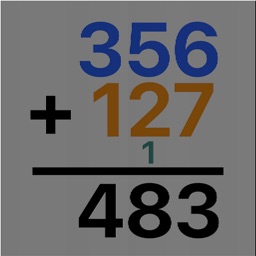
The app displays each invoice simultaneously in multiple representations:
- notation: the classic place value chart with numbers, carry-overs and underwrites, as it is written in the notebook.
- Plates: a two-dimensional place value chart in which each place value is represented as its own column and tiles visibly move when bundled or unbundled.
- Dienes 3DAn isometric view made up of cubes, rods, plates, and thousand cubes. It makes the spatial relationship between the place values immediately visible—a ten is ten times as large as a one, a hundred ten times as large as a ten.
- Language supportEvery step is accompanied by spoken guidance, both in writing and via speech output.
Changing a digit in the notation immediately shows the corresponding change in the other representations. The bundling and unbundling process is not only described but also animated. Ten ones bundle into a single ten, and a hundred flat is unbundled into ten ten rods.
Subtraction method
The app supports both subtraction methods commonly used in Germany:
- Unbundling (Subtraction method): The next highest digit of the minuend is reduced by one, and ten units are added to the current column.
- Expand (Fill-in method): The subtrahend is increased by one in the next higher column, the minuend remains unchanged.
Both methods can be switched between within the same task context. Even the difficult one. cascaded unbundling (for example, at) 900 − 191, where a borrowed unit has to travel across several locations) is fully animated and narrated.
Prediction tasks
Optional kann die App vor jedem Schritt eine Multiple-Choice-Frage stellen, oder das Kind muss direkt an den Repräsentationen handeln: „Was passiert als Nächstes?“ Das Kind sagt den nächsten Schritt vorher. Die App führt den Schritt erst danach aus. Die Distraktoren bilden bewusst typische Fehlvorstellungen ab, etwa „das Größere minus das Kleinere“ oder den vergessenen Übertrag.
Didactic background
Educational policy framework
Die schriftlichen Rechenverfahren sind seit der Verabschiedung der weiterentwickelten KMK-Bildungsstandards Mathematik 2022 deutlich anders didaktisch akzentuiert. Während die Bildungsstandards von 2004 die schriftlichen Algorithmen als zentralen Kompetenzbereich der Grundschule auswiesen, betonen die neuen Standards stärker das semi-written arithmetic und ordnen den schriftlichen Verfahren eine darauf aufbauende Funktion zu. Die wesentlichen Änderungen werden in einem Begleitartikel der Gesellschaft für Didaktik der Mathematik (Barzel et al. 2023) ausgeführt. Zwei Punkte sind für unsere Frage besonders relevant:
- Semi-written arithmetic is becoming more prominent. Semi-written strategies are understood as a prerequisite for children to learn to structure their own calculations, visualize intermediate steps, and understand their own thought processes. Written algorithms are only introduced once this foundation is solid (KMK 2022; Implementation Brochure KMK 2023).
- Understanding becomes the guiding principle. „Verstehen vor Automatisieren“ wird in der Implementierungsbroschüre programmatisch aufgenommen.
Die Bundesländer haben dies uneinheitlich umgesetzt. Der bayerische CurriculumPLUS For elementary school, for example, the following is explicitly written for subtraction: Deduction method (= unbundling) and names hundreds plates, tens rods and ones as key teaching materials (Bavarian State Ministry of Education and Cultural Affairs 2024). The North Rhine-Westphalia curriculum, on the other hand, leaves the choice of procedure open and delegates the decision to the schools (PIKAS 2024).
This means that a learning software that can be used nationwide both procedures zumindest darstellen können muss, um den Anschluss an das jeweilige Schulbuch zu erlauben. Darüber hinaus lassen sich dadurch sogar beide Verfahren vergleichend und verstehensorientiert untersuchen.
Was heißt „Verstehensorientierung“?
The concept has been central to German mathematics education since the second half of the 2010s and was developed in particular by Susanne Prediger and Christoph Selter (TU Dortmund) (Prediger & Selter 2014; Selter et al. 2014). Understanding-oriented mathematics teaching is characterized by three interconnected features:
- Priority of ideas over calculation. A sound understanding of numbers and operations must be established before formal arithmetic rules are introduced. Only on this basis can procedures be condensed into schemata (Prediger & Selter 2014).
- Consistent change of representation. Concepts and operations are interconnected across multiple levels of representation (concrete, iconic, symbolic, linguistic), allowing children to test and refine their own ideas when switching between the levels.
- Structural, intra-mathematical concepts. The promotion aims not only at motivating application contexts, but also at the recognition of mathematical structures, for example the bundling logic of the place value system (Prediger 2024).
Die App ist deshalb als ein Werkzeug konzipiert, das in diesem Sinne hilft, Vorstellungen aufzubauen and Repräsentationswechsel einzufordern, und das eine sprachliche Begleitung mitbringt, die als Modell für die kommunikative Bearbeitung dient.
Written procedures as bundling procedures
The written algorithms are taken directly from the decimal place value system Derived. Each column of a place value chart represents a grouping level; written addition is then a two-step process per column: add together, and if the column yields ≥ 10, group into a unit of the next higher place value. Copying is simply writing down this group (Padberg & Benz 2021, Chapter 8).
Das schriftliche Subtrahieren ist zweischrittig: vergleichen, und falls die obere Stelle nicht ausreicht, eine Einheit der nächsthöheren Stelle als zehn Einheiten der aktuellen Spalte verfügbar machen. Ob dies durch Reduktion des Minuenden („Entbündeln“) oder durch Erhöhung des Subtrahenden plus Aufstockung des Minuenden um zehn („Erweitern“) geschieht, ist eine Verfahrensfrage; mathematisch sind beide äquivalent (Padberg & Benz 2021).
Damit Kinder diese Logik tragfähig erfassen und nicht nur verständnislos mit Ziffern in Spalten rechnen, brauchen sie ein Understanding of bundling on the enactive and iconic level, before they work (purely) symbolically with notation.
Typical comprehension barriers
addition
The subject-specific didactics literature primarily documents the following error strategies for written addition (PIKAS 2024; Padberg & Benz 2021):
- Separation or complete transcription errorsThe child adds the column (e.g., 8 + 7 = 15) and writes the entire two-digit number in the ones column, instead of writing 5 and carrying over 1.
- Forgot to transferColumns are added correctly, but the carry-over from the previous column is not included.
- Incorrect handling of zero: Columns with
0are misinterpreted (e.g.0 + n = 0), or a carry to zero is not performed. - Place value reversal: When operands have a different number of digits, the digits are written one above the other, left-aligned instead of right-aligned.
subtraction
The range of obstacles is significantly broader in subtraction. The most common errors are (KIRA 2024):
- Difficulties with the transfer (no carry-over entered, no carry-over to empty spaces, one carry-over too many).
- Error with zero („0 − x = 0“, „x − 0 = 0“, kein Übertrag zur oder über die Null).
- Calculation direction error (counted from left to right).
- Operation reversal (Addition instead of subtraction).
- Spaltenweise Unterschiedsbildung „größere minus kleinere“ as the most common systematic error.
- Incorrect understanding of importance.
- Mixing several processes — for example, the simultaneous application of expansion and unbundling in the same task.
- One plus one error (Numbering error in the column itself).
The frequency of the „Größere minus Kleinere“-Fehlers. In a large-scale study of 31 fourth-grade classes in the Bielefeld region, Schipper documented as early as 1983 that this error accounts for approximately 30% of all subtraction errors and is thus the most frequent systematic error (Schipper 1983; cited in Padberg & Benz 2021). Wartha & Schulz (2014) show that this error reliably correlates with a weak understanding of place value.
In der App wurden basierend auf diesen häufigen Fehlern die Impulse und Vorhersagen für jeden Schritt gezielt angepasst und zusätzlich visuell verdeutlicht, um genau solche Fehler aufzugreifen, Fehlvorstellungen zu adressieren und durch die Repräsentationsvernetzung Lerngelegenheiten zu ihrer Überwindung anzubieten.
Procedural mix-ups
A separate hurdle arises when children expand and unbundle. mix. This error occurs empirically when textbooks and home-based support use different methods (Schipper 2009). This is partly because many parents still remember the extension method, while their children are now predominantly taught the unbundling method (Padberg & Benz 2021).
Erweitern vs. Entbündeln: Eine fachdidaktische Debatte
The two subtraction methods commonly used in German primary schools have been the subject of controversial debate for decades. The current state of affairs can be summarized as follows:
Unbundling (pulling method)
Logic of justification: The next highest digit of the minuend is reduced by one; the borrowed unit is added to the current column as ten units.
Strengthen (Padberg & Benz 2021; Krauthausen 2018; Bavarian State Ministry 2024):
- Direct connection to the enactive material activity: A ten-rod is divided into ten one-cubes.
- Consistent logic: only the minuend changes, the subtrahend remains the same.
- Cascaded borrowing can be represented as a spatial movement.
Weaken:
- Die Notation („Zehner durchstreichen, daneben −1 schreiben“) wird unübersichtlich, vor allem bei mehrfachem Borgen.
- For tasks such
1000 − 1A unit must cascade across three places.
Expansion (refilling process)
Logic of justification: The constancy of the difference: If you add the same value to both numbers (10 ones = 1 tens), the difference remains the same.
Strengthen (Schipper 2009; Padberg & Benz 2021):
- Clean notation, no deletions.
- Connection to the Add to („6 plus wieviel sind 13?“), das für viele Kinder kognitiv zugänglicher ist als das Abziehen.
Weaken:
- Die Begründung („wir geben oben 10 dazu und müssen das unten ausgleichen“) ist anspruchsvoll und am gegenständlichen Material schwerer zu zeigen. Selter (1995) bezeichnet diese Diskrepanz zwischen Material-Operation und notierter Operation als typische Fiction trap.
In der App werden für beide Verfahren Visualisierungen angeboten, um sie verständlicher zu machen. Beim Entbündeln wird ein Plättchen der nächsthöheren Stelle durchgestrichen und wird zu 10 Plättchen der nächstniedrigeren Stelle. Beim Erweiterungsverfahren wird ein „Minusplättchen“ (Verschwindeplättchen/Loch) hinzugefügt und als Ausgleich daraus 10 Plättchen der niedrigeren Stellen hinzugefügt.
Implementation in the app: Didactic design decisions
Die folgenden Designentscheidungen orientieren sich an den oben skizzierten fachdidaktischen Prinzipien.
Multiple representations synchronously
The central didactic decision is the synchronous coupling mehrerer Darstellungsebenen: jede Aktion (eine Ziffer ändern, einen Schritt ausführen) wirkt simultan auf Notation, 2D-Plättchen oder 3D-Dienes und sprachliche Beschreibung. Das ist genau das, was Bruner (1966) als Repräsentationswechsel beschreibt und was Krauthausen (2018) als zentrale Aufgabe digitaler Lernsoftware nennt: nicht Animation als Selbstzweck, sondern structurally identical Animating the mathematical relationships.
The roller shutters above each panel allow teachers to selectively one The aim is to conceal one level and force the children to translate from the others. This corresponds to the requirement of operative didactics (Wittmann & Müller 1990 ff.) to actively demand and increasingly anticipate shifts in representation. This allows for a wide variety of given-required tasks.
Explicit choice of procedure
Since the federal state curricula prefer different procedures, the app both procedures als gleichberechtigte Optionen bereit. Das adressiert auch die oben genannte Vermischungs-Hürde: Lehrkräfte können das Verfahren des eigenen Schulbuchs einstellen und gleichzeitig das alternative Verfahren zu Vergleichszwecken sichtbar machen als eine Möglichkeit, weil Kinder ihre eigene mentale Strategie oft nicht klar einem Verfahren zuordnen können.
Speech output as a model language
The speech output uses consistently Technically correct terms: „bündeln“, „entbündeln“, „Übertrag“, „Minuend“, „Subtrahend“. Sie macht den Algorithmus zu einer Erklär-Sequenz, an der sich die Kinder sprachlich orientieren können. Sie können das Sprachvorbild als Modell nutzen, das sie in eigene Worte übersetzen. Dies entspricht dem QuaMath-Prinzip Promoting communication (QuaMath 2024) and the one in Can definitely do math propagated practice, Verbalization to treat as a central part of mathematical understanding (Selter et al. 2014).
Prediction tasks
The optional forecast Before each step, the Predict-Observe-Explain-format of science education (White & Gunstone 1992). Instead of a mere animation that one watches, each step is framed by appropriate questions: What is happening here? What do I need to do here? Which distractor is plausible but false?
The app's distractors deliberately reflect the documented error strategies, for example „das Größere minus das Kleinere“, forgotten carry, reversed place values, procedural confusion, based on error analysis literature (Schipper 1983, 2009; Padberg & Benz 2021; Wartha & Schulz 2014; KIRA 2024). This results in a kognitive Aktivierung (QuaMath 2024) takes place.
Task generator and adaptive difficulty
Der Aufgabengenerator bietet mehrere Schwierigkeitsstufen und passt im Modus „adaptiv“ die Schwierigkeit der als nächstes angebotenen („gewürfelten“) Aufgabe anhand der Vorhersage-Trefferquote an.
Virtual Action: Challenging the Relationship Between Representations
During certain phases (placing the carry-over, entering the expansion correction), the multiple-choice question is replaced by a Tip task The material or the notation is replaced. The child points directly to the correct column and thus works on the iconic-symbolic level.
Limitations, research needs and practical recommendations
So vielfältig die Möglichkeiten der App sind, sie ersetzt weder das tangible material (Dienes cube you can touch) and that Talking about mathematics in the social space of the class. Krauthausen (2018, p. 215 ff.) points out that digital animations enhance the haptic experience add to, nicht ersetzen. Dasselbe gilt für die mündliche Bearbeitung: Kommunikation über Mathematik ist essenziell und nicht delegierbar (QuaMath 2024). Die App kann aber ergänzend und vor allem zum selbstständigen Üben und im Rahmen von Forscheraufgaben (in der App sind einige Ideen hinterlegt) genutzt werden.
Literature and further materials
- Barzel, B., Gasteiger, H., Greefrath, G., Maritzen, N., Nührenbörger, M. & Stanat, P. (2023). Further development of educational standards in mathematics for primary and lower secondary education. Communications of the Society for Didactics of Mathematics. https://ojs.didaktik-der-mathematik.de/index.php/mgdm/article/view/1113
- Bruner, JS. (1966). Toward a Theory of Instruction. Cambridge, MA: Harvard University Press.
- Krauthausen, G. (2018). Introduction to Mathematics Didactics — Primary School (4th ed.). Berlin/Heidelberg: Springer Spektrum.
- Padberg, F. & Benz, C. (2021). Didactics of Arithmetic — well-founded, versatile, practical (5th ed.). Berlin/Heidelberg: Springer Spektrum.
- Preacher, S. (2024). „Mathematik muss nicht wehtun.“ Beitrag im Deutschen Schulportal. https://deutsches-schulportal.de/expertenstimmen/susanne-prediger-didaktik-mathematik-muss-nicht-wehtun/
- Prediger, S. & Selter, C. (2014). Mathematics Education Update — Current Perspectives for Teaching and Learning Research and Teacher Education. https://wwwold.mathematik.tu-dortmund.de/prediger/veroeff/14-FuCo-Prediger-Selter.pdf
- Schipper, W. (1983). Typical student errors in written subtraction of natural numbers. Bielefeld University. https://pub.uni-bielefeld.de/record/1775198
- Schipper, W. (2009). Handbook for mathematics teaching in primary schools. Braunschweig: Schroedel.
- Selter, C. (1995). On the fictitiousness of the 'zero hour' in early arithmetic instruction. Mathematical teaching practice, 16(2), 11–19.
- Selter, C., Prediger, S., Nührenbörger, M. & Hußmann, S. (eds.) (2014). Mastering Mathematics with Confidence — A Diagnostic and Support Concept for Securing Basic Mathematical Skills. Themenmodul „Natürliche Zahlen“. Berlin: Cornelsen.
- Wartha, S. & Schulz, A. (2014). Preventing calculation problems (2nd ed.). Berlin: Cornelsen.
- White, R. & Gunstone, R. (1992). Probing Understanding. London: Falmer Press.
- Wittmann, E. Ch. & Müller, GN. (1990 ff.). Handbook of Productive Arithmetic Exercises, Volumes 1 and 2. Stuttgart: Klett.
Educational policy documents
- KMK — Standing Conference of the Ministers of Education and Cultural Affairs (2022). Educational standards for the subject of mathematics. Primary level. Decision of June 23, 2022. Berlin. https://www.kmk.org/fileadmin/Dateien/veroeffentlichungen_beschluesse/2022/2022_06_23-Bista-Primarbereich-Mathe.pdf
- KMK — Standing Conference of the Ministers of Education and Cultural Affairs (2023). Educational standards for mathematics. Implementation brochure for primary and lower secondary education. Berlin. https://www.kmk.org/fileadmin/Dateien/pdf/Bildung/Qualitaet/ImplBroschu__re_BiSta_MATHEMATIK_2023-03-23.pdf
- KMK & DZLM (2023). Agreement on the ten-year QuaMath program. Press release. https://dzlm.de/aktuelles/kmk_dzlm_quamath
- Bavarian State Ministry for Education and Cultural Affairs (2024). CurriculumPLUS Primary School — Mathematics. https://www.lehrplanplus.bayern.de/fachlehrplan/grundschule/3/mathematik
- Lower Saxony Ministry of Education (2024). Kerncurriculum für die Grundschule — Mathematik (Audio version). https://www.mk.niedersachsen.de/download/211766/KC_Mathematik_fuer_die_Grundschule.pdf
Online platforms and funding programs
- divomath — Digital teaching and learning environment for grades 3–6, TU Dortmund. https://www.schulministerium.nrw/divomath-mathematische-basiskompetenzen-digital-und-verstehensorientiert-foerdern
- KIRA — Children calculate differently. TU Dortmund / DZLM. https://kira.dzlm.de (especially). https://kira.dzlm.de/zahlen-und-operationen/schriftliches-rechnen/typische-fehler-bei-der-schriftlichen-subtraktion)
- Can definitely do math — Online materials. TU Dortmund / DZLM. https://mathe-sicher-koennen.dzlm.de
- PIKAS — Process- and content-related competencies. TU Dortmund / DZLM. https://pikas.dzlm.de (especially). https://pikas.dzlm.de/unterricht/zahlen-und-operationen/zahlenraum-bis-1000/schriftliche-addition and https://pikas.dzlm.de/unterricht/zahlen-und-operationen/zahlenraum-bis-1000/schriftliche-subtraktion)
- primakom — Primary school mathematics in a nutshell. TU Dortmund / DZLM. https://primakom.dzlm.de
- QuaMath — Quality of teaching and professional development in mathematics. DZLM / IPN. https://quamath.de/