Understanding numbers as compounds.
One Learning app for early mathematics instruction for laying, capturing,
Decomposing and assembling sets in the number range up to 10.
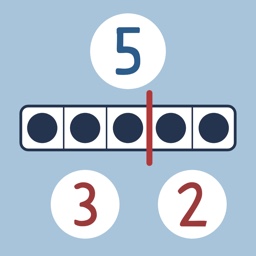
Web app to try out: dismantle.urff.app
Target audience: Initial instruction, grade 1, including support and learning therapy
Number range: up to 10
What is it about?
A number is more than just a place in the number sequence. Seven, for example, can be...
They can be seen as a whole, but also as a composition of 5 and 2, 4 and 3, or 6 and 1. Those who understand such part-whole relationships can use numbers flexibly, determine missing parts, and increasingly derive addition and subtraction problems from known number relationships, instead of counting each result anew.
The Disassemble supports children in building and deepening this part-whole understanding as an important foundation. A ten-strip structured in fives is used as a visual aid. Counters are placed, quantities are grasped at a glance, split into two parts using a movable dividing line, and put back together into a whole. The app combines four approaches:
- the action on the virtual material (adding and removing, moving a line)
- the structured quantity image with dividing line,
- the linguistic description and
- The symbolic representation using numbers and mathematical symbols.
All child-directed instructions and feedback are spoken. This allows the app to be used even by children who cannot yet read. Number selection, task scope, speaking pace, and practice options can be adjusted to the individual learning level in the teacher's area. Among other things, the children can…
- Place quantities in the ten-strip and assign matching digits,
- Increasingly grasping quantities without counting, using the five- and ten-structure.,
- to divide a whole into two parts and find different decompositions of the same number,
- to recognize that the parts can change while the whole remains the same,
- to determine the missing part of a whole and a known part,
- mentally fill in hidden quantities,
- switch between material, quantity image, number trio and symbolic notation,
- To understand addition as combining and subtraction as determining a part,
- Recognize exchange and inverse tasks as a related family of tasks and
- verstandene Zahlzerlegungen in zehn Spielen zunehmend sicher und flüssig nutzen.
The app is primarily designed for early learning, the transition from preschool to primary school, and is suitable for individualized support at any age. It can be used in primary and special education schools, in inclusive learning groups, in learning therapy, or at home.
Didactic concept
1. The part-whole concept as the basis of arithmetic
The part-whole concept describes the insight that a quantity or number can be divided into parts in various ways and reassembled from these parts. The whole remains intact as long as only its division is changed. Thus, 7 is the whole; 5 and 2 are parts of it. Likewise, 4 and 3 are parts of the same whole.
This insight is central to a relational understanding of numbers. Numbers are not only understood as successive positions – „six, seven, eight“ – but as interconnected quantities. The part-whole concept forms an essential basis for the concept of number, addition, subtraction, and subsequent calculation strategies.Lenz & Wittmann, 2023).
Intervention studies report positive learning effects of targeted part-whole instruction in kindergarten and early primary education. In a kindergarten study, an explicit part-part-whole curriculum showed greater learning gains than a program primarily focused on counting and numbering (Fischer, 1990). Another study found improved addition and subtraction skills after instruction that visualized number relationships (Kullberg et al., 2020In an experimental study, promoting decomposition strategies led to a higher solution rate, more flexible strategies, and less frequent counting (Cheng, 2012).
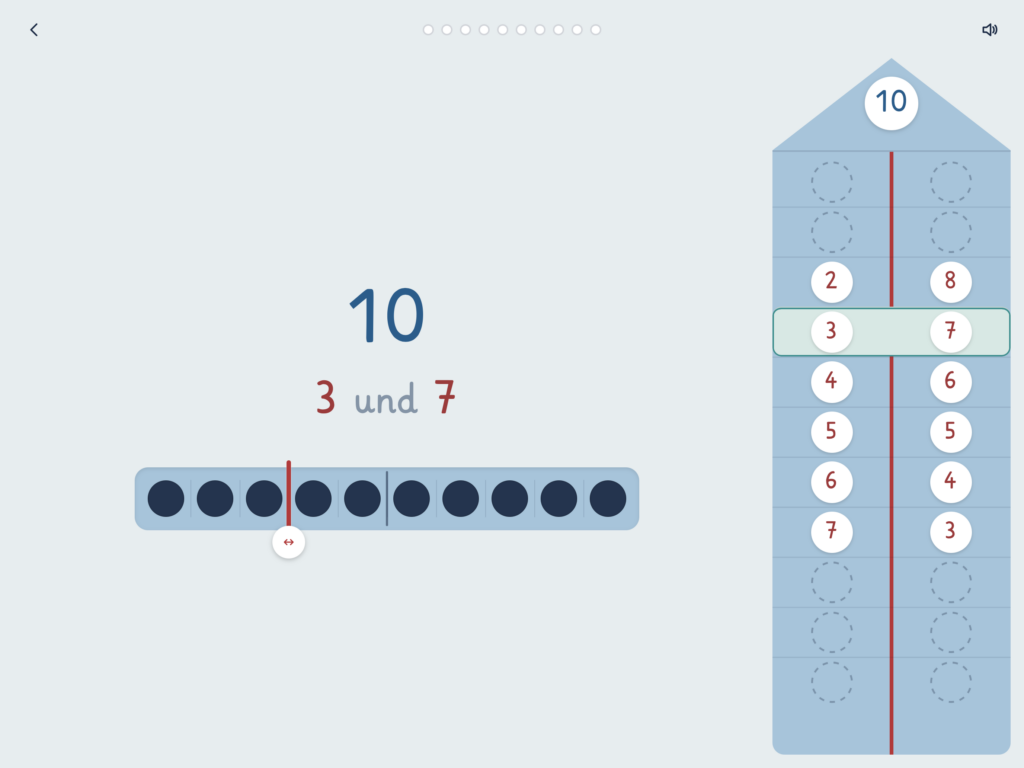
Implementation in the app: Dots on a ten-strip always show the quantity as a whole, which is divided into two visible parts by the red dividing line. The line can be moved without counters being added or removed. Thus, the invariance of the whole is directly experienced: one part becomes larger by one while the other becomes smaller by one.
2. Structured quantity recording
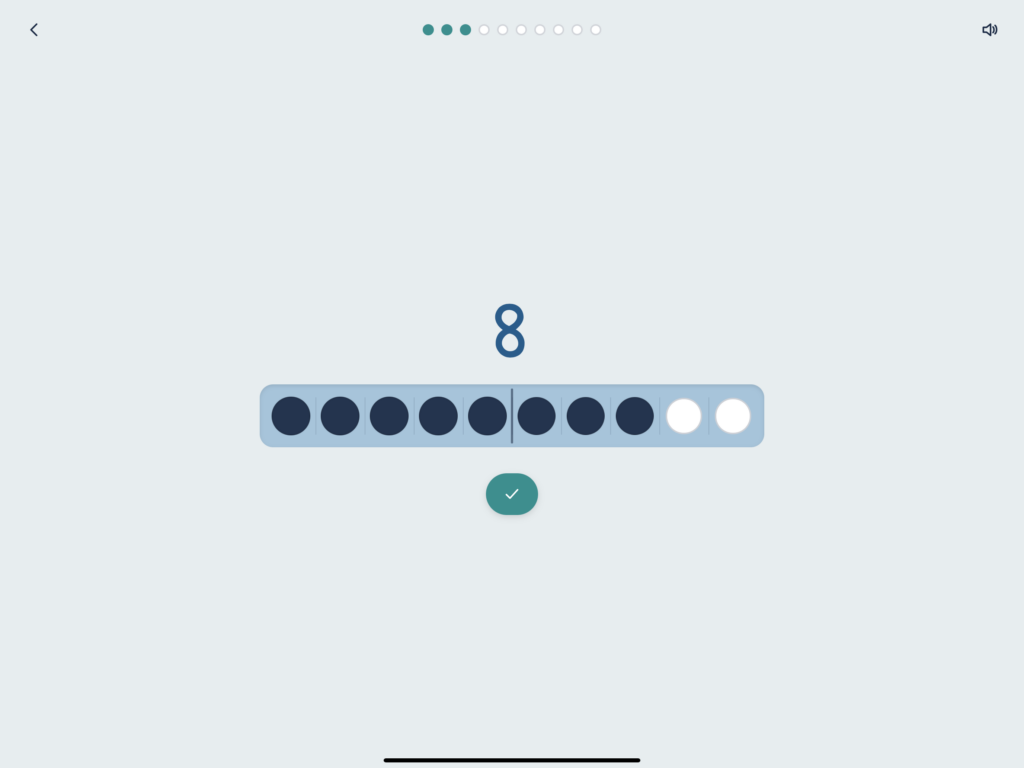
Larger quantities are easier to count when they are divided into manageable subsets. The ten-strip therefore utilizes the... Power of FiveAfter the fifth place, there is a marker. Eight can thus be seen as „five and three“ or as „two less than ten.“ For correct solutions, the app visually highlights matching five or ten relationships and names them verbally. In the event of errors, it deliberately does not simply count larger quantities forward. Instead, the quantity pulses as a group, and attention is directed to the structure. Only in the case of very small quantities, for which a five or ten anchor would be of little help, is support provided point by point. This design takes up the mathematics education requirement to perceive quantities in a structured way and to use number relationships to move away from counting-based calculation. It does not technically prevent counting—that would be neither possible nor sensible—but repeatedly makes other, long-term more viable perspectives accessible.
3. Linking action, image, language, and symbol
Simply moving a dividing line doesn't automatically lead to mathematical understanding. What's crucial is that the child connects the action with the quantity representation, the numbers involved, and a suitable linguistic relationship, and mentally comprehends the process. That's why the app consistently uses phrases like:
„"Seven is broken down into three and four."“
„"Three and four together make seven."“
„"Seven minus four equals three."“
The entire thing is blue, the parts are marked in red. The same role assignment appears on the ten strip, in the number trio, in the number house, and in the problem families. The color is not intended to replace thinking as a mnemonic device, but rather to draw attention to the mathematical role of a number: Is it in
This situation, all of it or part of it?
The various exercises deliberately require changes in representation: from the visible strip to the partial numbers, from the number trio to the material, from the hidden part to the addition, and finally from the structured image to the equation.
4. Find all decompositions, order them, and describe their relationships.
In the exercise „"Divide the crowd"“ Children don't just look for any decomposition, but for all decompositions of a chosen number. Found decompositions are collected in an organized way in a "number house." This allows a systematic approach to develop from trial and error. Systematic finding and ordering is important because it enables children to recognize relationships between the decompositions. The app provides a dynamic environment for this; describing and explaining the decompositions in classroom discussions remains the responsibility of the children and the teacher. Decompositions including zero can be enabled or disabled in the teacher's area.
When activated, it becomes visible that "0 and 7" also represent a possible decomposition of seven.
is.
5. Addition and subtraction as related relationships
The app integrates plus and minus and their interplay from a part-whole understanding. In the Add to that Two parts are assembled to form a whole. Take away the other part of the whole is being sought. In the exercise „"In and out again"“ The child initially adds a lot and
Then it removes exactly that part again. The removed tiles
They do not disappear without a trace, but remain as pale "ghost tiles".„
This is evident. The original whole, the removed part, and the remaining part can all be reconstructed simultaneously. The inverse relationship between addition and subtraction becomes tangible and visible through these actions. The app also includes exercises where the goal is not to add or subtract, but rather to determine the covered portion.
The exercise „"Task family"“ then combines a disassembly with the
associated equations:
3 + 4 = 7 4 + 3 = 7
7 − 4 = 3 7 − 3 = 4
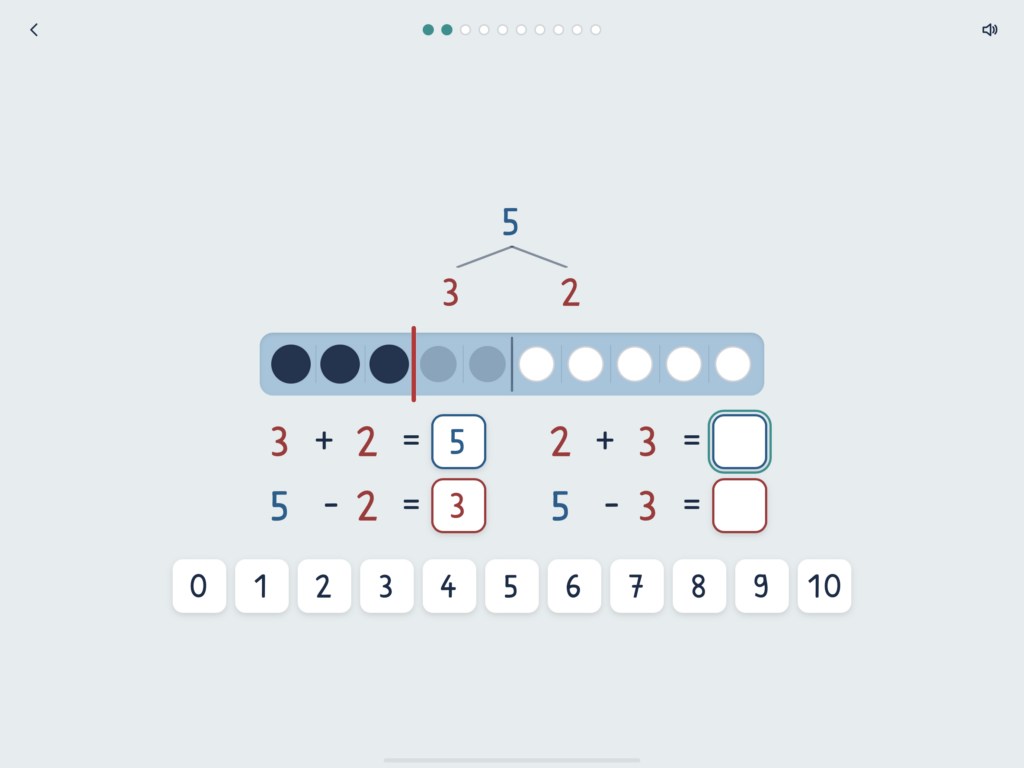
Each solved line is verified using the material. In subtraction problems, the whole is always written first. This is to ensure that the problem family doesn't become a mere rearrangement of three digits, but remains anchored in the common part-whole relationship.
6. Understanding-oriented feedback
A wrong answer is not marked as "wrong". The app draws attention to errors.
Returning to the material: A relevant subset pulses, a missing area becomes visible, a five/ten relationship is highlighted, or a verbal prompt is added. The solution is not given prematurely. The child can continue thinking and try again. For the progress overview, only the first attempt at a task counts. Afterward, the task is continued until the correct solution is found. This gives the teacher a cautious indication of what the child is already managing independently, without errors preventing the child from achieving a successful outcome. The overview is a supportive observation tool, not a standardized test or a basis for grading.
7. Automate only after understanding.
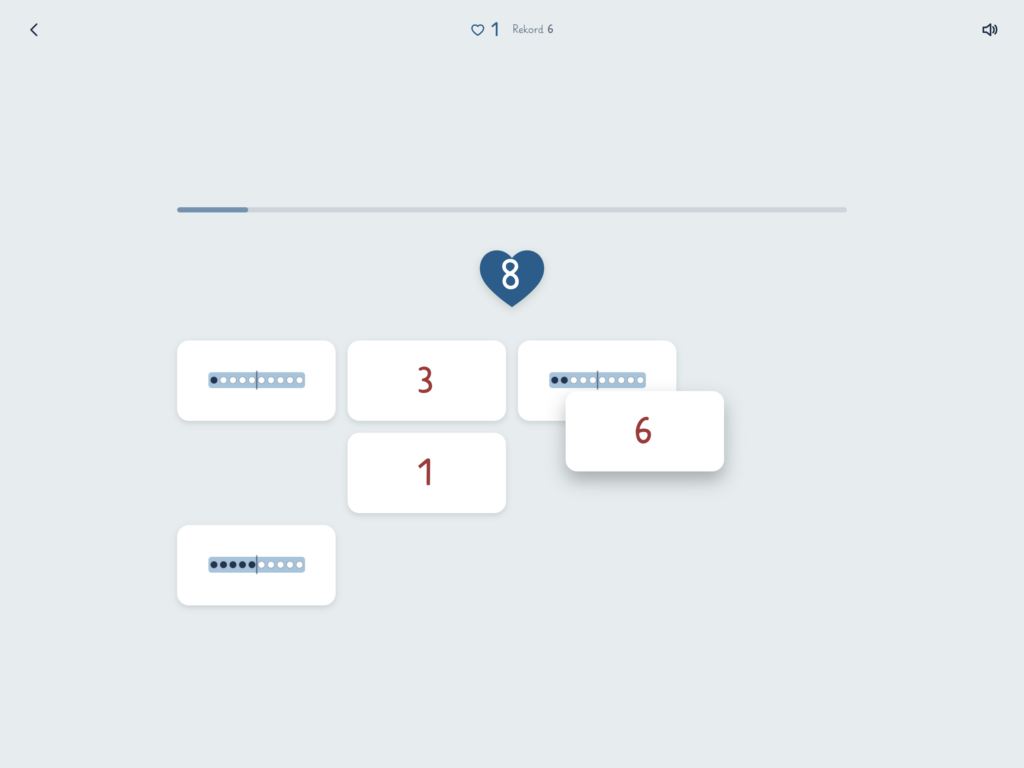
The games like „"Numbers in love"“, „Building houses“ and „Familie oder nicht?“ These games serve to reinforce previously understood decompositions and problem families. Numbers and structured quantity images alternate; matching pieces must be found, added, or assigned to a problem family. The games should only be used once a child can explain the relevant decomposition using the material. Speed and points can promote confidence and fluency, but they do not replace understanding. Therefore, game results are intentionally not included in the competency grid for the exercises.
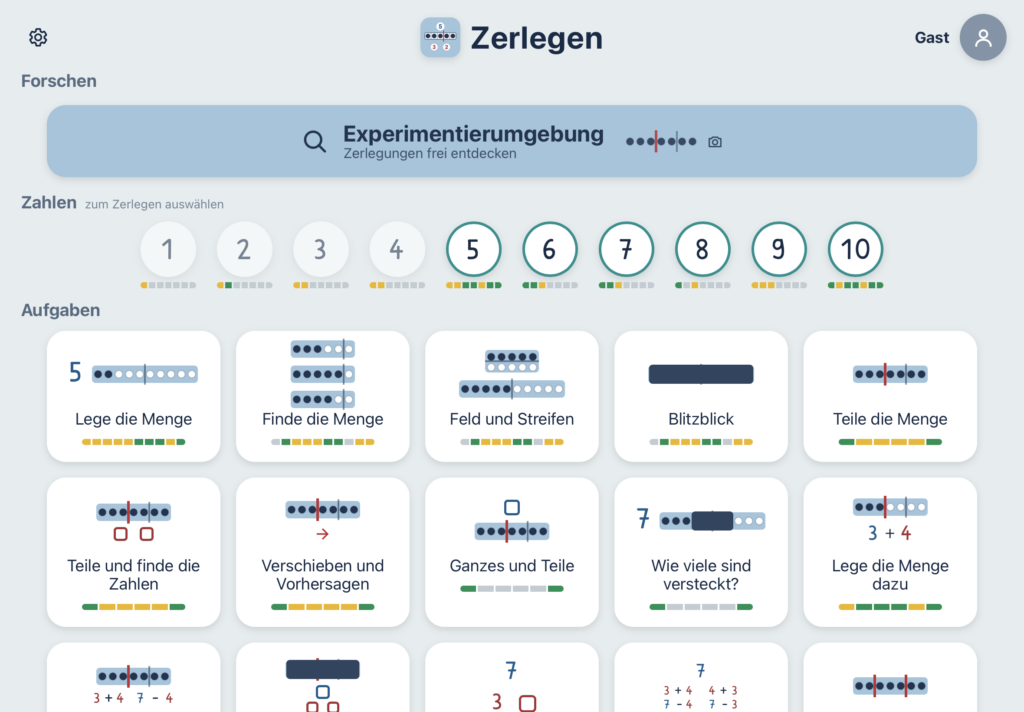
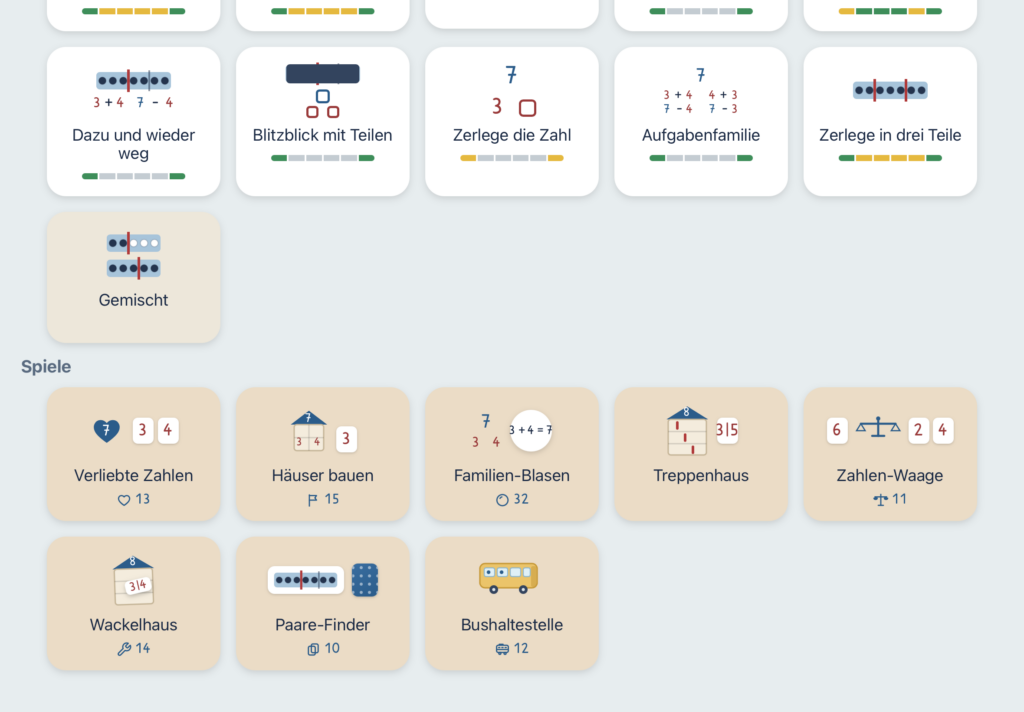
Overview of the training areas
| Learning focus | Suitable exercises | Central question |
|---|---|---|
| Quantities are laid down and recorded | Lege die Menge · Finde die Menge · Blitzblick · Feld und Streifen | „"How do you see the number without counting each tile individually?"“ |
| Change quantities | Add the quantity · Add and then remove it | „"What is added? What remains when the same part is taken away again?"“ |
| Examine disassemblies by action | Teile die Menge · Teile und finde die Zahlen · Verschieben und Vorhersagen · Muster zerlegen · Muster verschieden sehen · Zerlege in drei Teile | „Into which two parts is the whole divided? How do you find all the possibilities? How do the parts change when I change the line?“ |
| Determine parts and whole | Mengen zusammensetzen · Ganzes und Teile · Wie viele sind versteckt? · Blitzblick mit Teilen | „"Which part is known? Which part is missing? What is the whole?"“ |
| Internalize ideas | Break down the number | „"Can you first determine the missing part in your head and then check it on the strip?"“ |
| Understanding operational relationships | Umdrehen und tauschen · Aufgabenfamilie | „"What addition and subtraction problems belong to these three numbers?"“ |
| Explore freely | experimental environment | „"What changes when the line is moved – and what stays the same?"“ |
| Consolidate and automate | Verliebte Zahlen · Häuser bauen · Familie oder nicht? · Treppenhaus · Zahlen-Waage · Wackelhaus · Paare-Finder · Bushaltestelle · Geheime Durchfahrt · Lianen-Schnitt | „"Which decompositions and task families can you already confidently identify?"“ |
Use in mathematics teaching
Before first use
The app should not be started as just any random learning game without a joint content introduction. First, let children explore what „decompose“ or "break down" means using real materials and everyday language: A bar of chocolate can be broken into pieces; six counters can be split into four and two counters. It is important to accompany this with verbal cues such as:
„"Six is the whole. Four and two are parts of it. Together they make six again."“
Use the ten-strip and its five-marker specifically with the structure provided. Have the children describe how they quickly recognize a quantity. Flash-view exercises and a pen as a splitting line that can be moved are also well-suited for this.
Recommended learning scenarios
Depending on the learning level, phases can be repeated, shortened, or offered in parallel.
- Building quantity representations: Start with „Set the quantity“, „Find the quantity“
and slow „flash glance“. First choose a few numbers, such as 4, 5 and 6. - Disassembly as an action: Use the experimental environment and
„Divide the quantity“. Ask for the whole and the two parts. - Systematizing decompositions: Let's find all partitions of a number and
organize in the number house. Compare neighboring floors. - Identify missing parts: First, determine the parts covered together in the experimental environment without counting, then in "Whole and Parts", "How many are
hidden?“ and „flash glimpse with parts“ deepen - Internalize ideas: For example, use "Decompose the number". The material
It now appears primarily for monitoring and feedback. - Combine plus and minus: „In and out again“ and then the „family of tasks“.
- Secure and automate: Use the games and all other exercises when the relationships can be understood and described in words.
For most children, short, regular sessions of about 10 to 15 minutes are more beneficial than infrequent, long practice sessions.
Conversation starters
Suitable questions include, for example:
- „"What is the whole here? What are the parts?"“
- „"How did you see the crowd so quickly?"“
- „"Where do you see the five? How many more will be added?"“
- „"What happens to the left part if you move the line one/two/... place(s)?"“
- „"What changes? What stays the same?"“
- „"Have you found all the dissections yet? How can you be sure of that?"“
- „"Which decomposition is the exchange decomposition for this?"“
- „"Which addition problem matches the picture? Which subtraction problem?"“
- „"Why does the whole number have to be at the front in a subtraction problem?"“
- „"Can you predict the answer before you check it on the strip?"“
It is crucial that children not only state results but also describe and explain relationships. The app's speech output provides a language model for this. However, it cannot replace mathematical discussions with other children or the teacher.
Observations and impulses
| observation | Possible interpretation and next impulse |
|---|---|
| The child counts each tile individually. | Focus on the five-part structure: "Show me the five first. What else do you see?"„ |
| A displaced decomposition is interpreted as a new whole. | Address invariance and compare the whole thing before and after moving: „What has changed? What has remained the same?“ |
| Decompositions are repeated unsystematically. | Document as many decompositions as possible, including on paper, and then give the task: „Order the decompositions you found in a meaningful way. How did you order them?“ Possibly also provide a pre-existing order and have it continued. Put changes into words. |
| The child can only find the missing part by completely recounting. | Mark a known part and have it completed from the five- or ten-point anchor. Use relationships (one more, one less, exchange relationships). |
| 3 + 4 and 4 + 3 are treated as completely separate problems. | Compare both pulse trains on the same strip, describe the exchange relationship, and deepen the understanding with the help of the exercise „Turn Around and Exchange.“. |
| In the case of a minus sign, partial numbers are randomly swapped. | Issue research assignment: „Why is the whole always at the front with minus?“ The whole comes first; the subtracted part and the remaining part together make up the whole. |
| Symbolic tasks can be accomplished, but a suitable representation cannot. | Return to the number trio and switch to the strip of ten; have the equation demonstrated using the material. |
The app's child-centered learning progress overview shows, for each number, which areas have not yet been mastered, have been partially mastered, or have been mastered repeatedly. It is useful for teachers to plan further learning activities and also provides feedback on learning progress for the children themselves. However, individual failed attempts, time values, or color indicators should never be interpreted in isolation; they only become meaningful when considered in conjunction with observing actions and explanations.
Research project on the app
The learning effects of the specific digital learning environment under school conditions will be investigated in an accompanying study with pre-, post-, and follow-up assessments. This can be carried out quite easily (learning progress assessments can be conducted directly in the app). If you are interested in participating, please contact christian.urff@ph-weingarten.de
Role of the app in the classroom
The Disassembly is no substitute for real-world action or mathematical discussions. The app's particular strength lies in its ability to dynamically and consistently visualize mathematical relationships, to vary tasks in a targeted manner, to offer linguistic models, and to enable individualized practice paths. The greatest didactic benefit arises when digital activity is combined with manipulatives, drawing, speaking, reasoning, and collaborative reflection. The app is therefore particularly suitable…
- as a guided learning environment for the introduction of number decompositions,
- for short regular practice sessions (also at home),
- for partner work and mathematical discussions,
- for targeted support in cases of difficulties with number relationships or counting-based arithmetic and
- for securing and automating already understood disassemblies.
Literature and further materials
PIKAS inclusive: Basic task and advanced tasks „Decomposing numbers“
Cheng, Z.-J. (2012). Teaching young children decomposition strategies to solve additional problems: An experimental study. The Journal of Mathematical Behavior,
31(1), 29–47. DOI
Fischer, FE (1990). A part-part-whole curriculum for teaching numbers in the kindergarten. Journal for Research in Mathematics Education, 21(3), 207–215.
DOI
Gerster, H.-D. & Schultz, R. (2000). Difficulties in acquiring mathematical concepts in primary education. Report on the research project „Arithmetic weakness – identifying, remediating, preventing“. University of Education Freiburg.
Full text
Kullberg, A., Björklund, C., Brkovic, I. & Runesson Kempe, U. (2020). Effects of learning addition and subtraction in preschool by making the first ten numbers and their relationships visible with finger patterns. Educational Studies in Mathematics,
103, 157–172. DOI
Lenz, K. & Wittmann, G. (2023). To develop the part-whole concept in early mathematics instruction: What learning opportunities do textbooks offer for first grade? Journal for Mathematics Didactics.
DOI